As it is well known, oxidate layers on metal surfaces are a barrier for hydrogen penetration in and out of metal. In experiments, conducted at MEPhI Department “Plasma Physics”, it has been shown that hydrogen penetration through oxidate layers can be manipulated through radiation of surface oxide by atomic and ion flows. In particular, hydrogen penetration through the surface and its capture by metals accelerate under the radiation of oxidate surface by hydrogen atoms or hydrogen plasma with thermal velocity. If a surface-radiating ion or atomic flow has an oxygen admixture, hydrogen removal from metal takes place. This phenomenon has been called Radiation Enhanced Penetration – «REP».
Experiments conducted within 3 years at the department have allowed not only to detect these phenomena but also to study regularities of their manifestations in different cases (various metals, oxide layers, contents and radiation regimes).
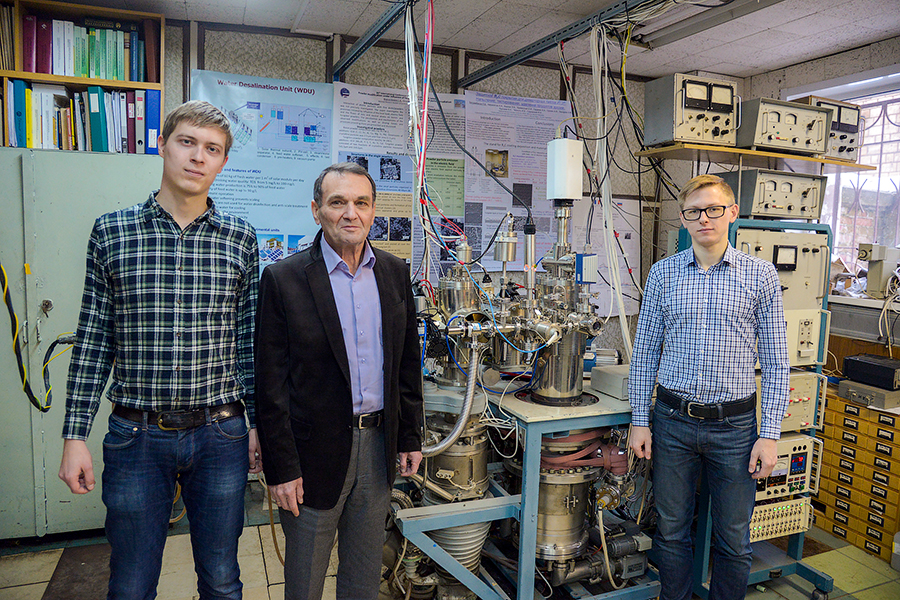
The work has been supervised (assigning the objective for the experiment, results’ discussion and, finally, determining the phenomenon’s nature) by Professor Leon Bergambekov. Post-graduate students A.S. Kaplevskiy and A.E. Evsin have conducted a large part of experiments on preparations for the experiment and its conducting, measuring of the phenomenon’s patterns in different conditions, processing and discussion of the experiment results.
The experiment results are important but the main value is understanding of the processes which determine the phenomenon, under which conditions and how it is shown, and thus how it (radiation enhanced penetration) can be handled.
Determination and explanation of this phenomenon are acute because they can help improve the work of many devices and facilities. For example, so-called neutron tubes serve for generation of neutron flows. One of the main tube’s elements is a thin titanium layer loaded with hydrogen isotopes. The higher is the concentration of hydrogen isotopes in the titanium layer, the larger are the flow of neutrons produced by the tubes and the tube time of work (its source).
The results of conducted experiments show what plasma composition should be like to prevent tritium gathering in materials which have contact with plasma and thus make the reactor exploitation safe.
Below you can see a group of the experiment’s developers: Professor Leon Bergambekov, post-graduate students A.S. Kaplevskiy and A.E. Evsin (Department №21).