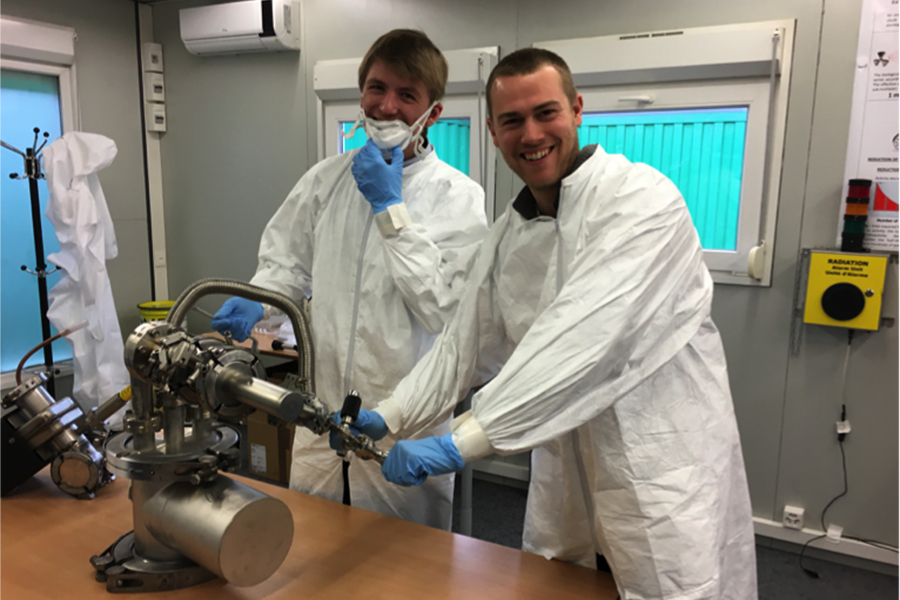
At the moment several postgraduate students of MEPhI Department №40 are undertaking internship in CERN, where they take an active part in research work related to conducted at LHC experiments. A postgraduate Daniil Ponomarenko talks about working in the lab to collect data fr om the TRT detector:
“A special system of control and data collection has been launched for successful analysis of data, received in proton-proton collisions at CERN. Since 1954 any detector cannot function without these systems.
The Transition Radiation Tracker (TRT) in the heart of the ATLAS experiment allows to measure tracks of charged particles and to separate the electrons from the pi-mesons. Members of the MEPhI Department №40 have been a key contributor in the development of TRT and now together with colleagues from other institutions provide its support.
TRT Data acquisition system (DAQ) is a complex consisting of several levels of signals’ digitization, formatting and data compression. The system operates in streaming mode and controls the internal time of the detector.
The collisions frequency at the LHC reaches record values of 100kHz and all systems, including the DAQ one, should work successfully with such loads. This is a serious challenge for developers of DAQ architectural solutions and software.
TRT DAQ system is as follows: signals from each proportional counter in TRT are digitized by the analog chip and is sent to a special board (DTMROC), wh ere several such signals build packets for a series of proportional counters. Then received packets go via patch-panels in the Read Out Drivers (or ROD). There signals are again combined into larger packets and after compression by special algorithms are sent to a main system of the ATLAS experiment, which make the decision whether to record this event or not depending on the command from the trigger system of the experiment.
Software for DAQ control system was developed by the University of Pennsylvania in cooperation with Siemens. Now, in a short break of LHC work during the winter vacation, it has become possible to make the necessary updates in the subsystems. TRT has replaced the computing power of DAQ from 32 to 64 bit systems that is associated with big changes in hardware and software systems. The group of MEPhI takes an active part in these works”.
In the photo: the postgraduate student of the MEPhI Department №40 Daniil Ponomarenko (left) with a colleague from the Manchester University is taking a course in radiation safety prior to the work with the TRT DAQ system