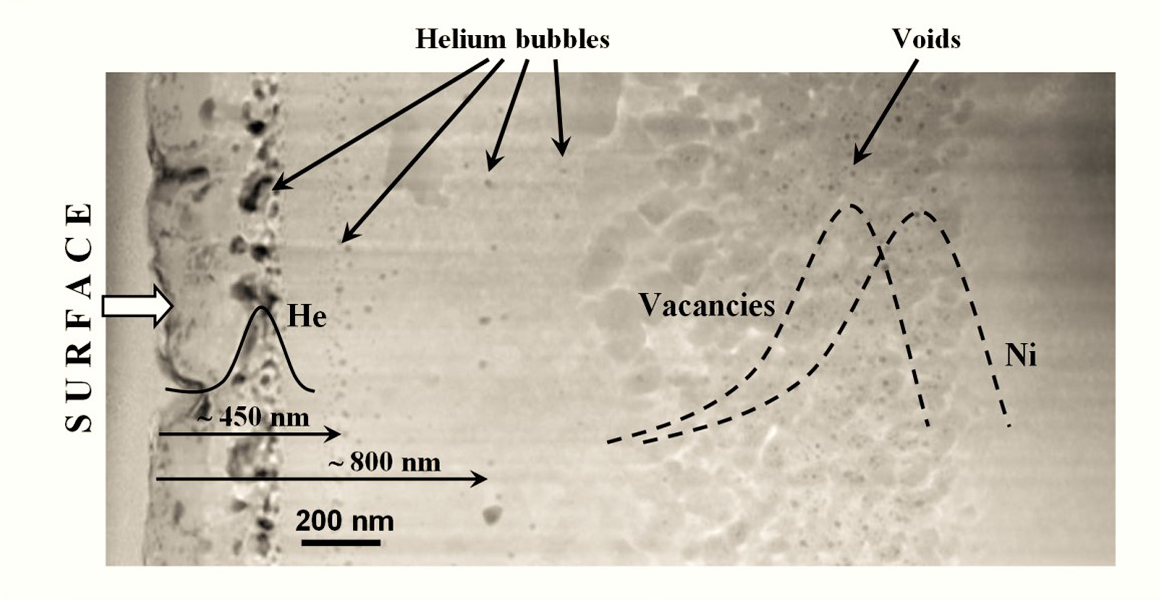
Centre for Nuclear Systems and Materials employees have shown and physically proved that in simulated experiments of radiation damageability with the use of heavy metal ions vacansion porosity in the zone of radiation damageability accumulation zone depends on the character of interaction of incorporated ions with the material of the target (solubility, phase formation) which imposes restrictions at the choice of ions for implants. It has been shown that the implanting of heavy metal ions into the target containing previously incorporated helium in a narrow surface layer transfers helium deep into the target, the spread of which is determined by the spread of vacancies and interstitial atom in running area of heavy ions, and radiation swelling in the maximum zone of vacansion spread is twice higher compared to radiation without helium incorporating which is to be considered while evaluating material radiation resistance on the first wall of fusion reactors.
Work called “Peculiarities of vanadium radiation swelling at consecutive nickel and helium ions radiation” by I.I. Chernov, М.S. Staltsov, and B.A. Kalin was nominated the most important result in radiation physics of solid body in 2015 at the itinerant session of RAS Academic Council on the problem "Radiation physics of solids" held in the end of November.
In connection with high radiation swelling of austenitic steel СhS-68 – main construction material of BN-600 active zone, austenitic high-nickel steel EK-164, low-swelling chromous steel like H13, including steel oxide dispersion-strengthened as perspective materials for fuel rod cladding. Vanadium allays with rapid decay of induced activity, the most researched of which is V-4%Ti-4%Cr, are considered to be perspective construction materials for active zones of nuclear and especially first walls of fusion reactors.
That determines the actuality and novelty of the research of patterns of forming of faulted structures, porousness, swelling, helium and hydrogen behaviour in new construction materials after imitation radiation by ions of different mass and energy (see the Figure).
Below: microstructure of alloy V-0,3 pts. wt.% Ti, radiated in consequence He+ + Ni2+, along running area of Ni2+ and pores as the result of radiation (FIB technology, «underfocus» regime).