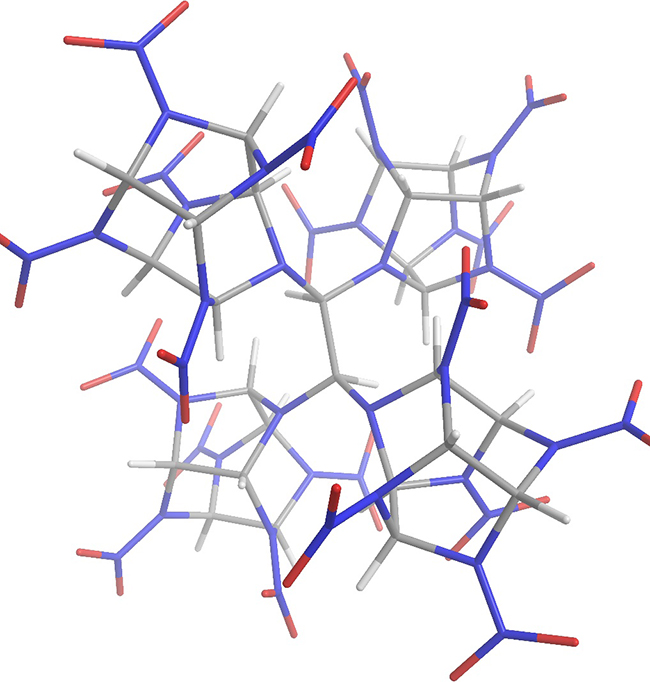
MEPhI researchers by means of computer-aided simulation as a part of density functional theory have shown that CL-20 molecules can covalently bind, not directly, but with the help of “molecular bridges” making dimers and tetramers (Fig.2) stable at liquid nitrogen boiling temperature.
That means there is a possibility of getting covalent crystals CL-20, and covalent bond between CL-20 can provide a closer packing of these molecular systems, raise kinetic stability of crystals, improve energy efficiency and, most likely, reduce the costs.
The potential of further search of covalent crystal structures on the basis of CL-20 has been welcomed by the Council for the RF President's Grants. Employees of the Department of Condensed Matter Physics and the Centre of nanostructured electronics have won a 2016 contest grant for state support of research conducted under the supervision of leading scientists. It has been planned to make a detailed computer-aided simulation using the methods of quantum physics and chemistry of potential covalent crystal structures on the basis of CL-20 molecules and consider the opportunity of raising stability of these crystals because of the optimal choice of “molecular bridges” connecting them. In case of success it will be possible to make a prognosis of a consistent set of physical-chemical characteristics of new materials and make direction for search of their effective synthesis methods which will stimulate future developments.
Chemical compound CL-20, first synthesized in 1987, belongs to high-energy-density materials (HEDM). Technological process of getting CL-20 was worked out in 90-s, and nowadays it is considered as one of the components of fuel elements of new generation. However, there are impediments to wide usage of CL-20, in particular, its high cost and complexity of production of necessary degree of purity.
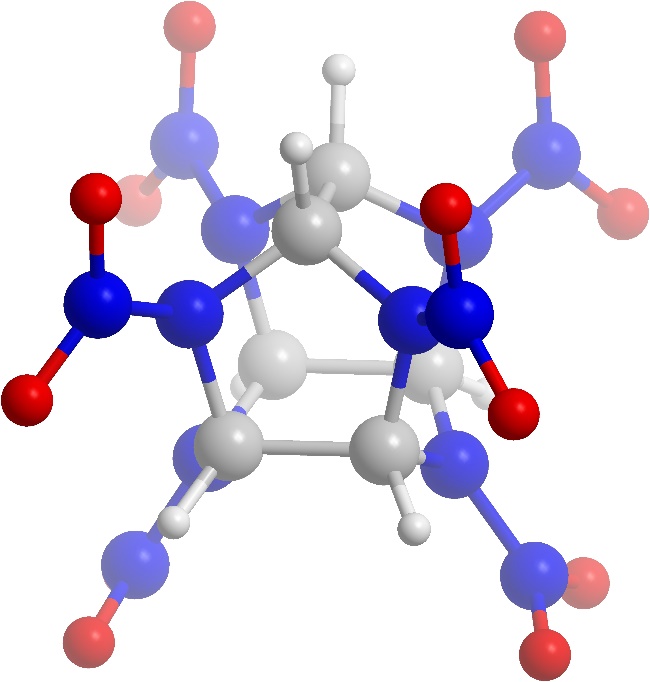
CL-20 is an isolated molecule with a carbon-nitrogen construction formed of two pentatomic and one hexatomic ring with six functional nitrogroups connected with carbon-carbon bonds (Fig.1).
Figure 1. CL-20 molecule
Figure 2. Covalent crystal CL-20 fragment (tetramer)